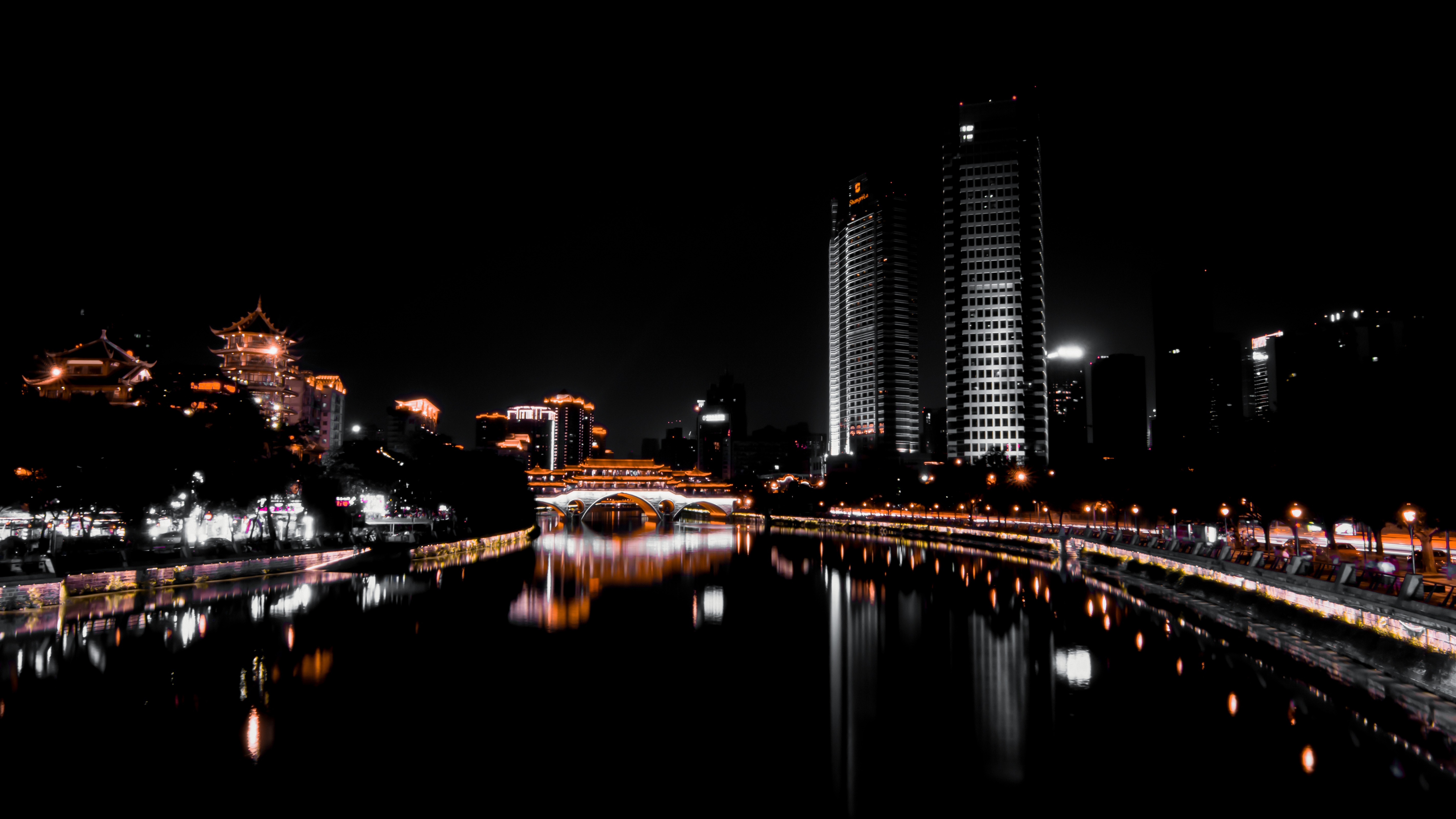
This striking landscape captures the harmonious duality of Chengdu’s urban identity, anchored by a meticulously composed symmetrical frame. The Jin River flows horizontally through the center, functioning as a natural mirror that perfectly doubles the architectural elements lining its banks. A gracefully arched bridge occupies the midground, its warm golden illumination guiding the viewer’s gaze toward the distant horizon while establishing a strong structural focal point. Flanking the waterway, softly lit pedestrian promenades and mature trees introduce a subtle human scale, contrasting with the vertical dominance of the background skyline. The lighting strategy relies entirely on artificial sources, leveraging the deep velvety darkness of the night sky to maximize luminous contrast. Traditional Chinese pavilions on the left radiate rich amber and orange tones, evoking historical warmth and cultural continuity. In direct opposition, sleek modern high-rises on the right emit cooler white and blue glows, symbolizing technological advancement and contemporary urban growth. This deliberate chromatic juxtaposition creates a dynamic visual tension that is seamlessly resolved by the reflective surface of the river. The interplay of warm and cool tones across the water generates a layered, almost ethereal depth, transforming the urban canal into a canvas of light. The color palette is anchored by profound blacks and navy blues, which allow the vibrant golds, ambers, and whites to achieve maximum visual impact. The reflections exhibit a soft, diffused quality, suggesting a long exposure technique that smooths the water’s texture while preserving the sharpness of illuminated structural lines. The resulting mood is deeply contemplative and cinematic, evoking a quiet interlude within a rapidly evolving metropolis. Geographically and culturally, the scene encapsulates Chengdu’s unique narrative: a city where ancient Sichuan architectural heritage and cutting-edge modern development coexist without conflict. The tranquil waterway, historically vital to regional irrigation, now serves as a reflective stage for the city’s architectural evolution, offering a serene visual meditation on progress and preservation. The symmetrical arrangement not only reinforces visual stability but also emphasizes the deliberate urban planning that integrates recreational public spaces with commercial development. The absence of visible crowds or vehicular traffic strips away urban noise, allowing the architectural forms to speak directly through their illuminated silhouettes. This deliberate stillness enhances the photograph’s meditative quality, positioning the viewer as a quiet observer of a city at rest. Ultimately, the image transcends mere documentation of a riverside skyline. It functions as a visual thesis on Chengdu’s evolving identity, proving that historical reverence and futuristic ambition can share the same frame without diminishing one another.