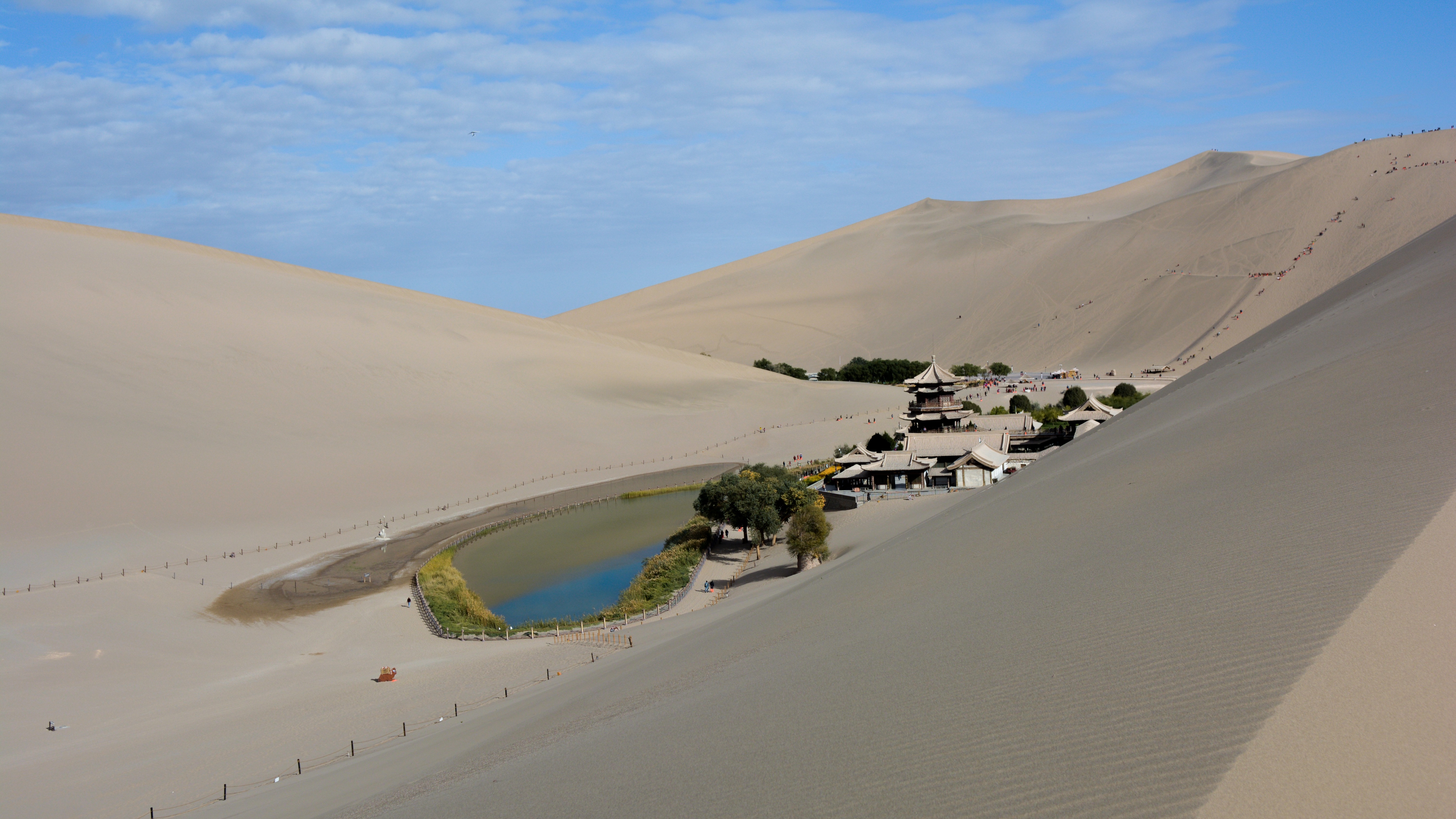
Stepping onto the sun-baked slopes of Mingsha Shan, I was immediately struck by the impossible harmony of this desert oasis. The wind carried a faint, melodic hum from the shifting sands, a natural symphony that has guided Silk Road travelers for centuries. I hiked to a higher vantage point on the eastern dune, knowing it would offer the perfect panoramic perspective to frame Yueyaquan, or Crescent Moon Spring. Through my viewfinder, the composition revealed itself almost instantly. I chose a wide-angle lens to embrace the immense scale of the sweeping dunes while keeping the crescent-shaped lake anchored in the lower-left quadrant. The traditional pavilions resting near the water’s edge provided a crucial human element, their tiered roofs and dark wooden accents contrasting beautifully against the pale beige sands. Shooting under bright midday light is often considered a challenge, but here the high sun worked in my favor. It carved soft, defining shadows across the dune contours, emphasizing the delicate wind ripples without blowing out the sky. I exposed carefully to preserve the deep turquoise of the water and the vibrant green of the surrounding reeds. As I waited for a few visitors to wander into the frame, the scene transformed from a static postcard into a living narrative. The crisp, dry air of western China rendered every detail with hyper-realistic clarity, from the fine grains of sand to the distant cirrus clouds streaking the azure canopy. There is a profound stillness to this place that transcends the bustling tourist paths. Standing there, camera steady against my chest, I felt a quiet reverence for nature’s resilience. Water thriving in an arid expanse, ancient architecture enduring centuries of desert winds—it all speaks to a delicate balance that demands both awe and respect. I pressed the shutter, capturing not just a landscape, but a fleeting moment of tranquil wonder. This image is my tribute to that enduring harmony. To maintain the expansive depth of field, I stopped down to f/8 and used a polarizing filter to cut through the atmospheric haze and intensify the sky’s natural saturation. The resulting image balances the raw, untamed energy of the desert with the gentle, life-sustaining presence of the spring. Every photograph I take in Gansu Province feels like a dialogue between time and terrain. The midday clarity here strips the landscape to its essential forms, revealing the true geometry of the dunes and the reflective calm of the oasis. I adjusted my composition slightly to the right, allowing the sweeping curves of the sand to form a natural corridor that guides the viewer’s eye directly to the architectural complex. Human figures, though small, became vital scale references, reminding us of our own transience in such a vast environment. When reviewing the histogram later, I was relieved to see a clean distribution of tones, with no clipped highlights on the bright sand and rich shadow detail in the pavilion eaves. This photograph is more than a visual record; it is an emotional anchor, pulling me back to the quiet hum of the singing sands and the profound peace of standing at the edge of a desert miracle.