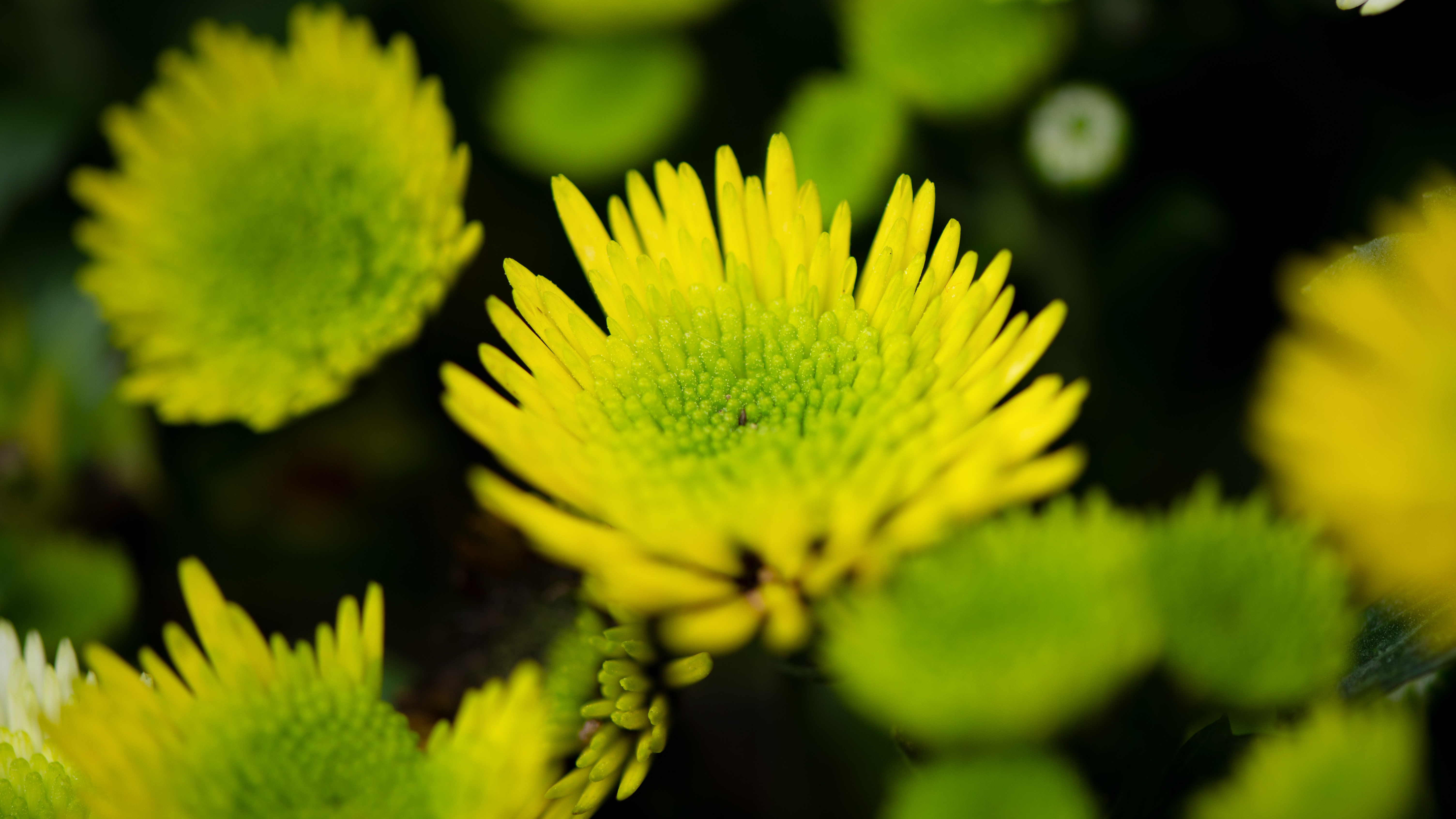
I remember standing perfectly still as the morning light filtered through the overcast canopy, casting a gentle, diffused glow over the garden bed. There it was, a solitary yellow chrysanthemum that seemed to command the entire frame. I adjusted my tripod, breathing slowly to steady my hands, and knew instantly that I needed to capture this quiet moment of natural harmony. The composition demanded intimacy, so I leaned in close, allowing the tightly packed, spiky petals to radiate outward from their textured, lime-green core. To isolate the intricate architecture of the central bloom, I dialed my aperture down to f/2.8. This shallow depth of field was crucial, transforming the surrounding buds and dark foliage into a soft, painterly wash of color while keeping the primary subject razor-sharp. The technique is often called bokeh, but for me, it is less about a technical term and more about guiding the viewer’s eye exactly where I want it to rest. I focused meticulously on the honeycomb-like cluster of tiny florets at the heart of the flower, noticing how the subtle variations in light gave the petals a luminous, almost glowing quality. Shooting from a slightly elevated angle helped sculpt the three-dimensional form of the blossom, emphasizing its delicate symmetry without flattening the image. As I reviewed the histogram, I felt a profound sense of calm wash over me. The absence of harsh shadows meant the colors remained true to life, saturated yet entirely organic. This photograph is not just a record of a seasonal bloom; it is an invitation to pause and appreciate the quiet resilience of nature. In the cultural tapestry of East Asia, the chrysanthemum symbolizes longevity and rejuvenation, and I wanted my lens to honor that quiet dignity. Every fine hair on the petal edge, every subtle shift from bright yellow to deep verdant green, tells a story of careful cultivation and natural grace. When I finally pressed the shutter, the resulting image felt like a visual poem. It bridges the gap between hyper-realistic documentation and impressionist abstraction, proving that sometimes the most profound narratives are found not in sweeping vistas, but in the microscopic details of a single, radiant flower.