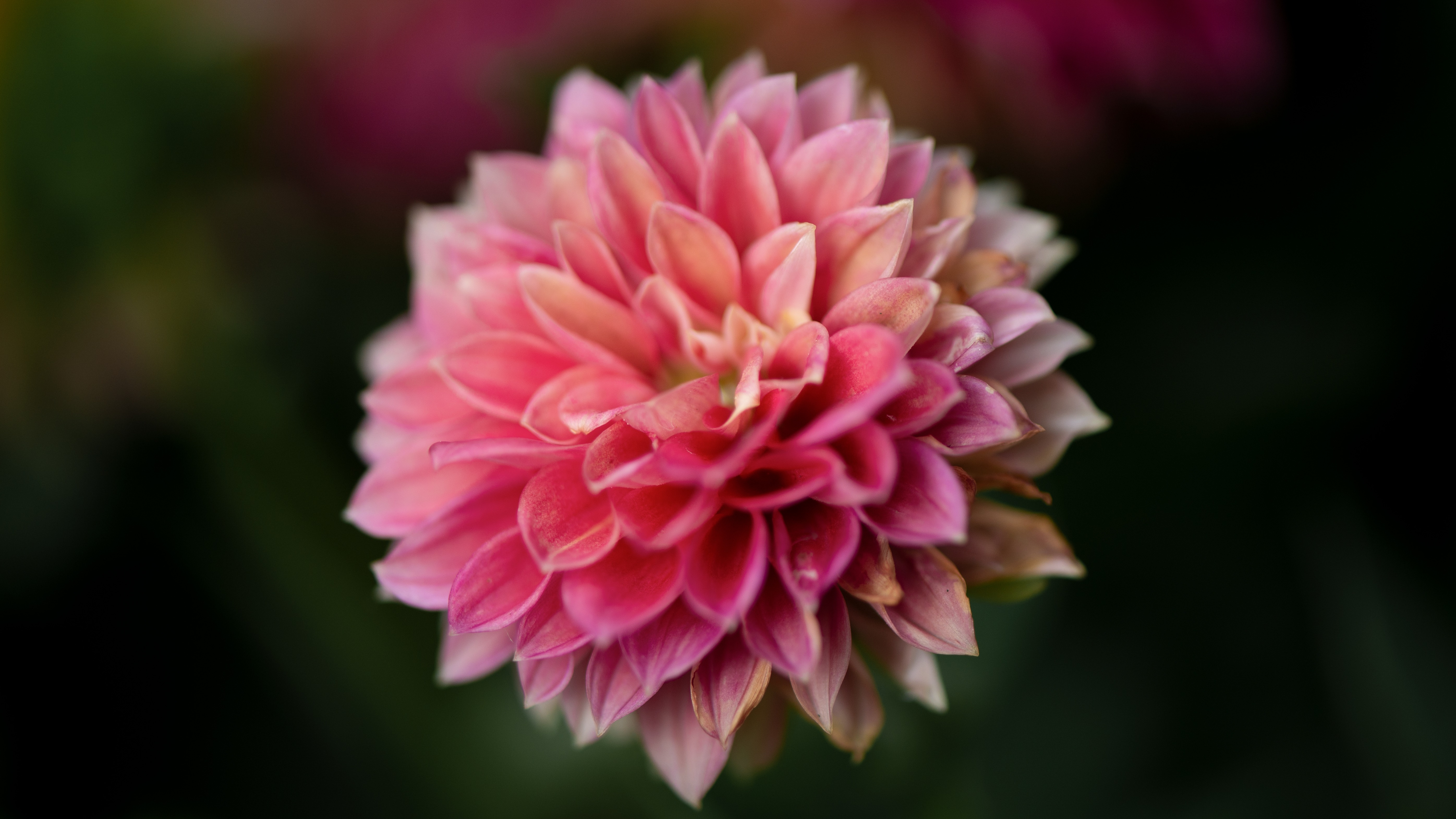
I remember the quiet morning I found this dahlia. The air was cool, and the overcast sky acted as a giant softbox, diffusing the daylight into a gentle, even glow. I had wandered into a tucked-away garden bed, drawn by a flash of rose and magenta peeking through the leaves. As I knelt down, I knew I had to capture that exact moment of stillness. I adjusted my camera to a wide aperture, dropping down to f/2.8 to create a shallow depth of field. This choice was crucial. It allowed the intricate, ruffled layers of the petals to pop in razor-sharp focus while melting the surrounding foliage into a smooth, painterly bokeh of dark greens and muted purples.
Shooting macro flowers is an exercise in patience and observation. I positioned myself slightly above the bloom, angling the lens downward to emphasize its near-spherical architecture. Every petal spirals outward from that dense center, creating a natural vortex that pulls the eye inward. I avoided any heavy post-processing, preferring to let the natural color gradation speak for itself. The pale blush at the edges transitions seamlessly into deeper magenta and peach tones near the core. By relying entirely on the ambient light, I preserved the translucent quality of the petals, giving them an almost ethereal, delicate weight.
There is a profound sense of tranquility in macro photography. When you strip away the noise of the wider world and frame just a single subject, you begin to notice the quiet strength hidden in nature’s design. This dahlia, often associated with dignity and inner resilience, felt like a silent testament to careful cultivation and organic grace. The absence of human structures or artificial lighting reinforced that feeling. It was just me, the camera, and a fleeting moment of botanical elegance. I hope that when you look at this image, you feel that same calm. I invite you to slow down, lean in closer, and appreciate how much beauty exists when we simply take the time to look.