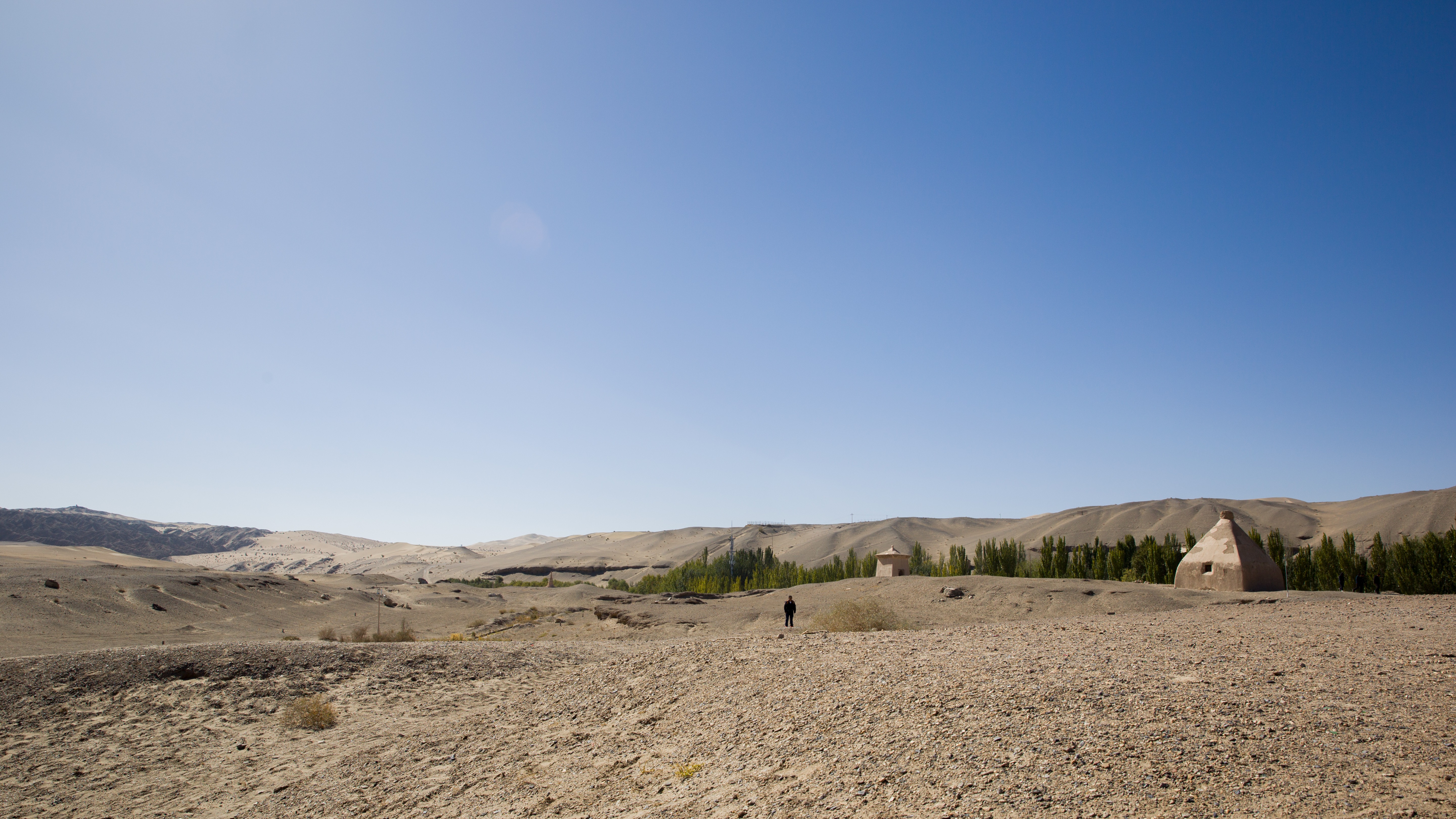
I remember standing in that exact spot, the heat pressing down like a heavy blanket as the midday sun bleached the color from the dunes. When I first raised the viewfinder, I wasn’t looking for grand drama; I was searching for stillness. The landscape demanded patience. I waited until a lone traveler, clad in dark, wind-worn fabrics, stepped into the mid-ground. His presence instantly anchored the composition, transforming an empty expanse into a meditation on human scale. I deliberately placed the horizon line low, following the rule of thirds to let the immense, cloudless sky claim two-thirds of the frame. This negative space does more than fill the image; it breathes. It emphasizes the quiet weight of isolation. On the right, a weathered conical mud-brick structure rises from the earth, its geometric form echoing the ancient rhythms of the Silk Road. I framed it carefully so it wouldn’t compete with the figure, but rather converse with the distant poplar trees and low, barren foothills. Technically, shooting in harsh midday light is often discouraged, but here, the direct sun worked in my favor. It carved out sharp, short shadows that revealed the gritty texture of the gravel and the subtle undulations of the terrain. I exposed for the highlights to preserve the deep, saturated blue of the sky while letting the earthy ochres and dusty beiges of the ground fall into rich, natural midtones. There were no clouds to soften the light, just raw, unfiltered clarity. Through the lens, I felt a profound sense of timelessness. The silence of that place is heavy, broken only by the imagined whisper of wind sweeping across the sand. Every element—the solitary walker, the enduring mud architecture, the resilient green of the oasis trees—tells a story of adaptation and endurance. This photograph isn’t just a record of geography; it is an invitation to pause, to stand in the vastness, and to feel the quiet pulse of a landscape that has witnessed centuries of journeys. To achieve this stark clarity, I used a narrow aperture of f/11, ensuring crisp focus from the foreground gravel to the distant ridges. I kept my ISO at the base level to eliminate noise, allowing the natural grain of the scene to speak for itself. The minimalist approach required ruthless editing in my mind before pressing the shutter. I removed any visual clutter that might distract from the core narrative of solitude. The resulting image feels almost painterly, with broad swathes of negative space guiding the eye naturally from the foreground figure, past the architectural accent, and toward the fading horizon. It’s a reminder that sometimes, less truly is more. When you look closely, you don’t just see sand and stone. You see the enduring dialogue between humanity and the earth.