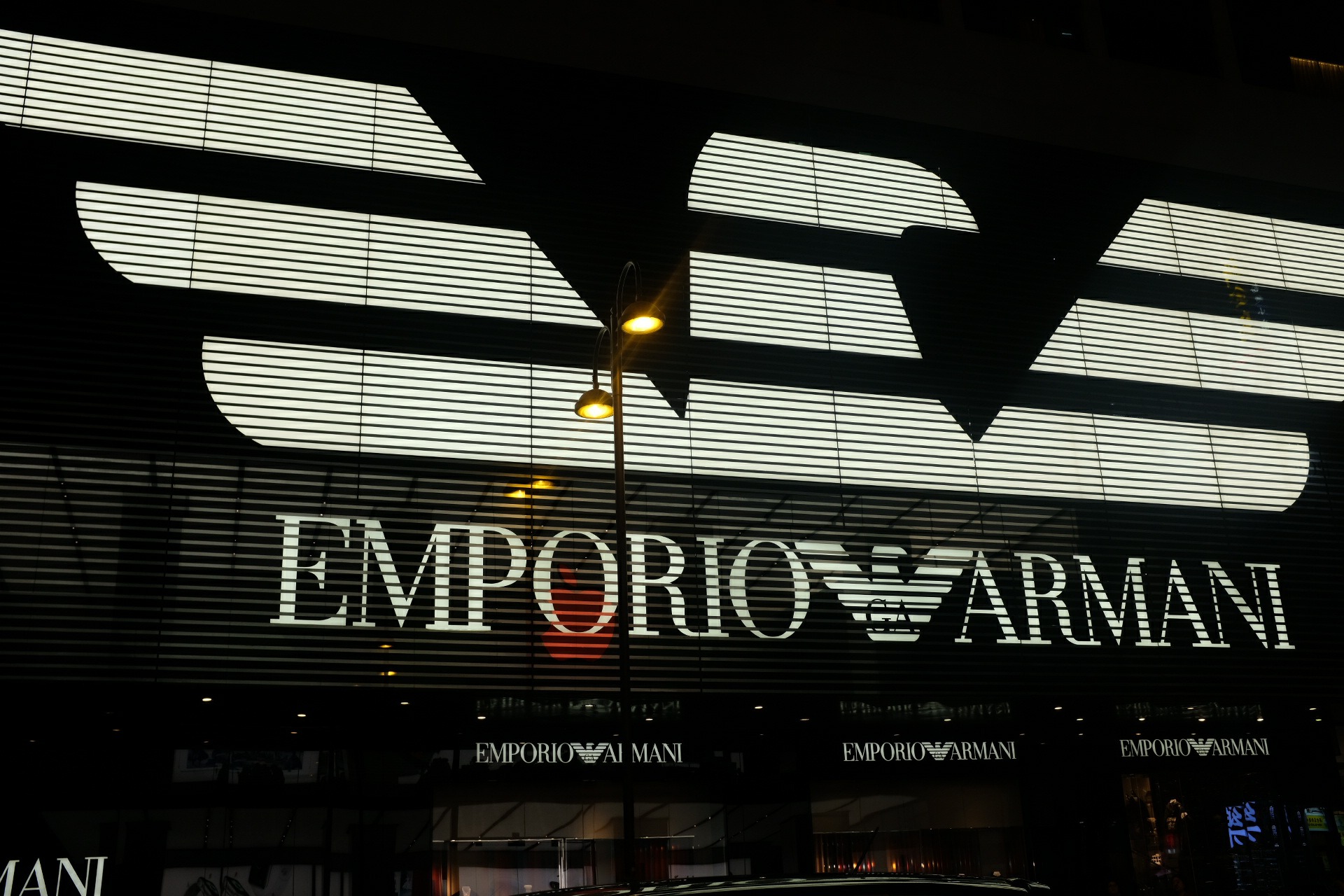
Standing beneath the towering glass and steel of the retail district, I felt the city breathe differently after dark. The neon hum of commerce fades into a quiet, almost reverent stillness, and that is exactly when architecture truly speaks. I had my tripod firmly planted on the cool pavement, waiting for the perfect moment when the ambient traffic would clear and the building’s own illumination could take center stage. The Emporio Armani façade rose above me, a monolith of light and shadow that demanded to be framed. I positioned my camera at a low angle, tilting the lens upward to emphasize the sheer verticality and graphic precision of the signage. The iconic eagle and bold sans-serif lettering acted as a natural anchor, while the horizontal slats above them created a rhythmic, almost musical pattern against the night sky.
To capture this interplay of artificial glow and deep shadow, I relied heavily on a long exposure technique. By slowing the shutter speed and stopping down the aperture, I allowed the sensor to drink in every gradient of the diffused white light. This approach smoothed out the luminous quality of the backlit panels, transforming what could have been a harsh commercial sign into a softly glowing, sculptural element. The deep blacks of the surrounding sky remained perfectly intact, creating a stark, high-contrast canvas that highlights the brand’s minimalist ethos. A solitary streetlamp in the foreground accidentally found its way into the frame, but rather than cropping it out, I embraced the warm amber halo it cast. That subtle color temperature clash against the cool white signage added an unexpected layer of depth and grounded the otherwise abstract geometry.
As I watched the histogram on my monitor, I realized this wasn’t just a documentation of a luxury storefront. It felt like a quiet meditation on modern urban life, where commerce, design, and light converge into a single visual statement. The faint red reflection near the lettering reminded me that even in the most controlled environments, the city leaves its unpredictable fingerprints. Packing up my gear hours later, I carried away more than a single image. I carried the lingering sense of how a city transforms when the crowds disperse and the architecture steps forward to claim the night. Every frame I compose is an invitation to look closer, to find the poetry in concrete and glass, and to let the quiet intensity of the urban landscape speak for itself.